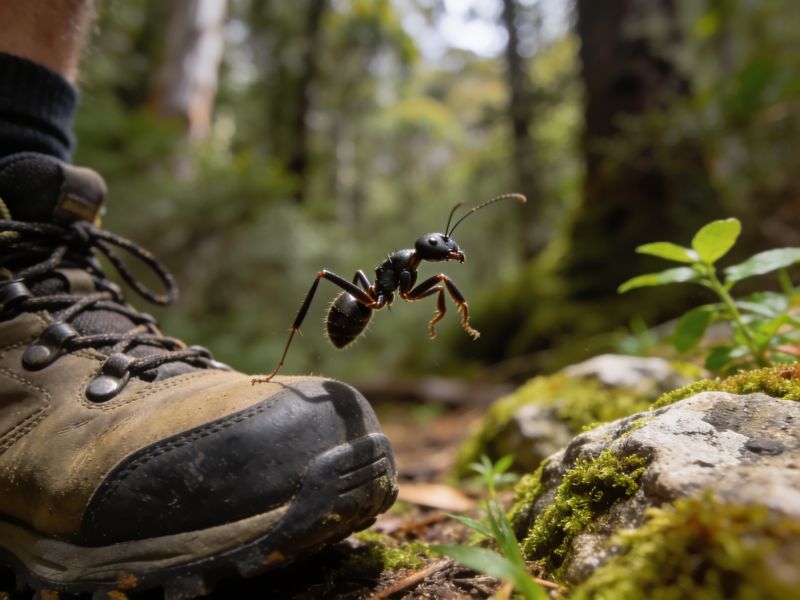
Jack jumper ants。more formally known as Myrmecia pilosula, are a species of bulldog ant native to southern Australia and Tasmania. They earn the name "jumping ants" from a startling behavior: when threatened, workers can leap several centimeters off the ground to launch themselves at a perceived attacker. I first encountered this while hiking near Hobart, Tasmania—a single ant on a fallen log suddenly sprang toward my boot, landing with a audible tick. It wasn’t a random hop. The insect had locked onto my shadow and deliberately closed the distance.Physically, these ants are hard to mistake. Workers measure 10–12 mm。with a slender black body, long mandibles, and a reddish-brown tint on the thorax in some populations. Their vision is exceptional for ants—large compound eyes detect movement up to a meter away. That visual acuity explains the jumping behavior: rather than waiting to be stepped on, a forager can track a looming threat and catapult itself onto the target. The jump is powered by rapid extension of the middle and hind legs, a mechanism that also lets them spring backward to escape. I’ve watched one vault from a twig to a rock—a horizontal leap of roughly 15 cm—without any run-up. It looked less like an insect and more like a tiny gymnast.The sting is where jumping ants demand serious respect. Their venom contains pilosulin peptides。
and the pain is immediate, intense, and lasting—often described as a hot needle driven into the skin. What’s less known: up to 3% of the Australian population is allergic to jack jumper ant venom, and reactions can escalate to anaphylaxis. In Tasmania, these ants cause more severe allergic reactions than honeybees. A colleague of mine, a field biologist, was stung on the wrist and within minutes developed hives across her torso;she now carries an adrenaline auto-injector on every survey. The ants don’t pursue humans aggressively, but disturb a nest and hundreds of workers pour out, each capable of multiple stings. Their colony structure is polygynous—multiple queens per nest—which allows populations to rebound quickly after disturbances. Nests are typically underground, marked by a low mound of soil and gravel, often hidden in dry sclerophyll forest or coastal heath.
Ecologically, jumping ants are generalist predators and scavengers. They take insects, spiders。and nectar, and they’re known to tackle prey nearly their own size. On a warm afternoon in the Blue Mountains, I watched a worker drag a paralyzed huntsman spider—easily three times its body weight—back toward a nest entrance. The ant gripped the spider’s leg and walked backward, pausing only to sting the prey again when it twitched. That kind of tenacity shapes local invertebrate communities;areas with dense jack jumper populations often show reduced numbers of ground-dwelling spiders and other ants.For anyone hiking in southeastern Australia, a few practical notes. Wear enclosed shoes—thongs and sandals offer zero protection. Avoid sitting on or near low mounds of gravelly soil. If a single ant lands on you, flick it off rather than swatting;a crushed ant releases alarm pheromones that recruit nestmates. And if you’re stung and feel dizzy, short of breath。or develop a widespread rash, seek emergency care—jack jumper ant stings are no minor annoyance. That tiny leap isn’t a party trick. It’s a precise, defensive weapon from an insect that has clearly earned its name.